2026-09-24
Hongdae Dermatology: Why Melasma, Lentigines, Age Spots, and Nevus of Ota Require Different Treatments
Hongdae dermatologist Dr. Go-eun Lee explains why melasma, lentigines, age spots, and nevus of Ota require tailored laser treatments, detailing device selection and post-laser skin care.
“Aren’t all brown spots on the face just melasma?”
“Which pigmentation laser machine works best?”
“I’ve had repeated pico laser sessions, but I haven’t seen much improvement.”
Hello, I am Dr. Go-eun Lee from Nine Clinic Hongdae.
When consulting patients with pigmentation concerns, many assume that any brown spot on the face is either melasma or general blemishes.
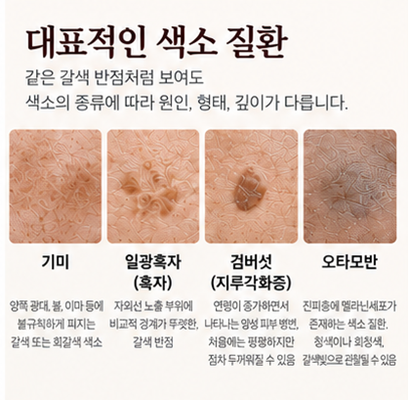
However, facial pigmentation comes in many diverse types, including melasma, lentigines, seborrheic keratosis (age spots), freckles, and nevus of Ota.
Even if they look like similar brown spots on the surface, their underlying causes, morphology, and pigment depth differ—which means treatment approaches must differ as well.
Today, I will explain the causes behind these common pigmentary lesions and which pigment lasers can be utilized depending on your skin’s condition.
Melasma, Lentigines, Age Spots: Why Do They Occur?
Melanin in the skin plays a crucial role in protecting us from ultraviolet (UV) radiation.
However, various factors can trigger an overproduction of melanin or cause it to accumulate in specific areas, leading to visible pigmentary lesions.

Melasma typically presents as irregularly shaped brown or grayish-brown patches spreading symmetrically over the cheekbones, cheeks, or forehead.
UV radiation is widely recognized as a major aggravating trigger, compounded by a complex interplay of hormonal shifts and genetic predisposition.
Lentigines—specifically solar lentigines (sun spots)—are closely linked to cumulative UV exposure.
They frequently appear as well-defined, distinct brown spots on sun-exposed areas such as the face and the backs of the hands.
Seborrheic keratosis, commonly known as age spots, is a benign skin lesion frequently observed in adults.
These lesions tend to increase in number with age; they may start as flat brown macules and, over time, develop a thickened, elevated, or warty surface.
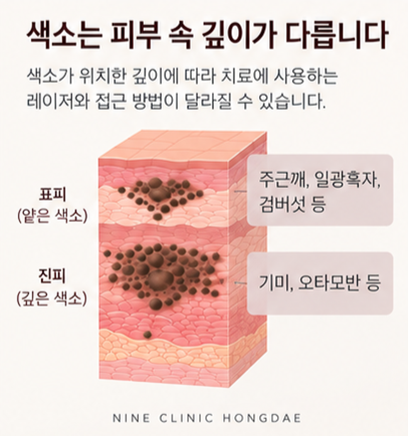
In contrast, nevus of Ota is a dermal pigmentary disorder where melanocytes reside deep within the dermal layer of the skin.
Because it often appears with a bluish, slate-gray, or brownish tint, its therapeutic approach differs fundamentally from that of superficial pigmentation.
As you can see, lesions that look similar to the naked eye can represent completely different types of pigmentation.
Therefore, it is difficult to determine an effective treatment plan based solely on visual color and surface shape.
Pigmentation Treatment Begins with Assessing Skin Condition
In practice, it is common to find multiple types of pigmentation coexisting on a single individual's face.
For instance, someone may have widespread melasma across the cheekbones with overlapping solar lentigines.
In such cases, instead of treating the entire face with a single uniform method, each lesion and the overall skin condition must be carefully evaluated.
At Nine Clinic, alongside in-depth clinical consultations by medical professionals, we use Mark-Vu skin imaging analysis to examine pigment distribution, skin tone, facial flushing, and overall skin condition.
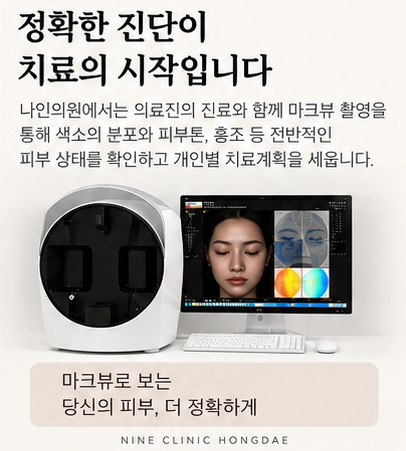
By comprehensively evaluating visual lesion features, skin diagnostic results, and past treatment history, we customize the choice of laser devices and determine optimal treatment intervals.
Laser Selection Depends on the Type of Pigmentation
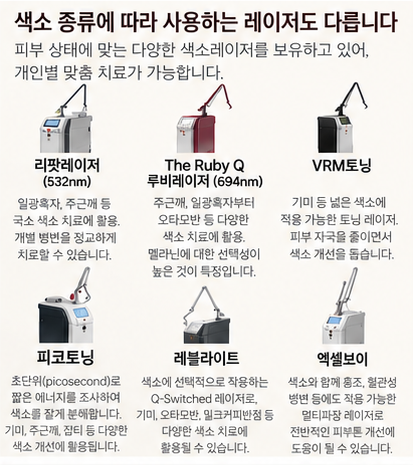
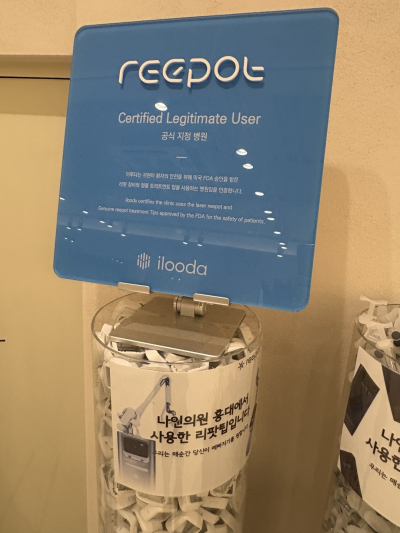
The Repat laser utilizes a 532nm wavelength and is highly effective for localized, sharply bordered pigment lesions such as solar lentigines.
Unlike broad toning methods that repeatedly deliver energy across the whole face, it features the ability to target individual lesions precisely.
Additionally, Nine Clinic utilizes The Ruby Q ruby laser from JMEC (Japan) for pigment treatments.
The ruby laser operates at a 694nm wavelength, renowned for its exceptional selectivity toward melanin.
The Ruby Q is engineered to deliver uniform energy across the treatment area, making it adaptable across varying depths—from superficial pigmentation like freckles and solar lentigines to deep dermal lesions such as nevus of Ota.
On the other hand, widespread pigmentation like melasma requires a completely different approach.
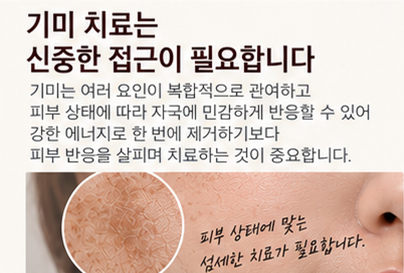
Because melasma involves complex contributing factors and can react hyper-sensitively to thermal or mechanical irritation, it is vital to treat gently while observing tissue response, rather than attempting aggressive removal with high energy in a single session.
In these cases, modalities such as VRM toning, pico toning, or RevLite can be applied according to the patient's skin barrier condition.
Furthermore, if pigmentation is accompanied by facial redness, vascular lesions, or uneven skin tone, Excel V laser may be combined.
Excel V utilizes multiple wavelengths to comprehensively address both vascular and pigmentary concerns, making it an ideal concurrent modality depending on clinical presentation.
Ultimately, utilizing diverse pigment lasers is not about applying every device at once, but about selecting the exact tool required for your skin's current status.
Post-Laser Care Is Equally Essential
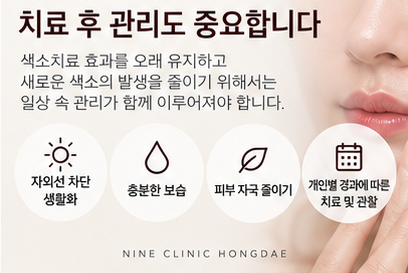
Pigmentation treatment does not end in the laser suite.
Because UV exposure can worsen melasma and trigger new solar lentigines, diligent sun protection during and after the treatment course is essential.
Since the skin may become temporarily sensitized following laser procedures, providing ample hydration and avoiding unnecessary physical or chemical irritation is crucial.
Depending on the type and depth of pigmentation, noticeable improvements may be observed after a single session, while other lesions require staged sessions and long-term monitoring.
Rather than aiming to eradicate all spots in one aggressive attempt, it is far safer and more effective to proceed progressively while monitoring your skin's healing response.
If You Are Considering Pigment Treatment
Pigmentation can develop slowly over years of cumulative sun exposure, and can darken due to changes in skin health or hormonal shifts.
Consequently, even after successful clearance, new spots can emerge or existing pigments may gradually reappear.
Therefore, rather than viewing pigment therapy merely as a short-term cleanup, it should be approached as a collaborative journey of managing current lesions while safeguarding long-term skin health.
Above all, incorporating daily sunscreen habits and minimizing unnecessary skin irritation will go a long way in maintaining a clear complexion.
If you have been troubled by pigmentation, instead of merely comparing specific laser brand names or session counts, I encourage you first to examine what changes are genuinely taking place within your skin.
I hope today's explanation has helped you better understand diverse pigment conditions like melasma, lentigines, and age spots.
Thank you.

Also,
did you know we have a YouTube channel?
We share concise and informative videos covering various aesthetic procedures, so please feel free to drop by 😊

Goeun Skin Go-eun Lee Share videos with friends, family, and the world www.youtube.com
Frequently Asked Questions
Are all brown spots on the face considered melasma?
No. Brown facial spots can be melasma, lentigines, seborrheic keratosis (age spots), freckles, or nevus of Ota. Despite their similar appearance, their causes and dermal depths vary, requiring accurate differential diagnosis and customized treatment modalities.
Which lasers are used to treat solar lentigines?
Solar lentigines are primarily targeted using Repat laser or Q-switched ruby lasers. The Repat laser uses a 532nm wavelength to treat distinct localized lesions, while The Ruby Q ruby laser provides high melanin selectivity, making it highly effective for superficial lesions.
Why shouldn't melasma be treated with aggressive, high-energy lasers all at once?
Melasma responds sensitively to thermal irritation, and excessive laser energy can trigger post-inflammatory hyperpigmentation (PIH) or worsen the condition. A gentle, progressive approach using pico toning, RevLite, or VRM toning while monitoring skin tolerance is recommended.
How is pigmentation treated when accompanied by facial flushing or redness?
In cases with concurrent redness or vascular lesions, Excel V laser is often combined. Excel V's multiple wavelengths target both abnormal vascular structures and melanin, providing broad improvements in both flushing and pigmentation.
What is the most crucial aftercare following pigment laser procedures?
Diligent UV protection and deep hydration are paramount. UV rays trigger recurrence and worsen melasma and sun spots. Because the skin barrier may be temporarily delicate post-treatment, avoiding harsh friction or irritants is essential for optimal recovery.