2026-09-12
Hongdae Dermatology: Is That Brown Pigmentation Melasma or Lentigo? A Doctor with 15 Years of Experience Explains
Learn the vital differences between melasma and solar lentigo from an expert Hongdae dermatologist with 15 years of clinical experience. Accurate diagnosis comes before choosing laser treatments for brown spots on the face.
“Is this brown pigmentation melasma? Or is it a solar lentigo?”
“It looks similar to pictures I found online. Should I just get laser toning?”
Hello, this is Dr. Go-eun Lee from Nine Clinic in Hongdae.

Many patients visiting our Hongdae dermatology clinic for pigmentation concerns often wonder about the difference between melasma and lentigo (sun spots).
When looking in the mirror,
both may seem like similar brown spots,
but just because they share a brown color
does not mean they are the same type of pigment.
It could be melasma, it could be lentigo,
and often, different types of pigmented lesions coexist
on the very same face.
Therefore, in pigmentation treatment,
identifying the exact nature of the visible pigment
is far more crucial than immediately choosing which laser machine to use.
Today, focusing on solar lentigo—commonly known as sun spots or age spots—
I will carefully explain how melasma and lentigo differ,
and what key aspects we look at during consultation and examination.
Melasma and Lentigo: What Kinds of Pigment Are They?
• What is Melasma?
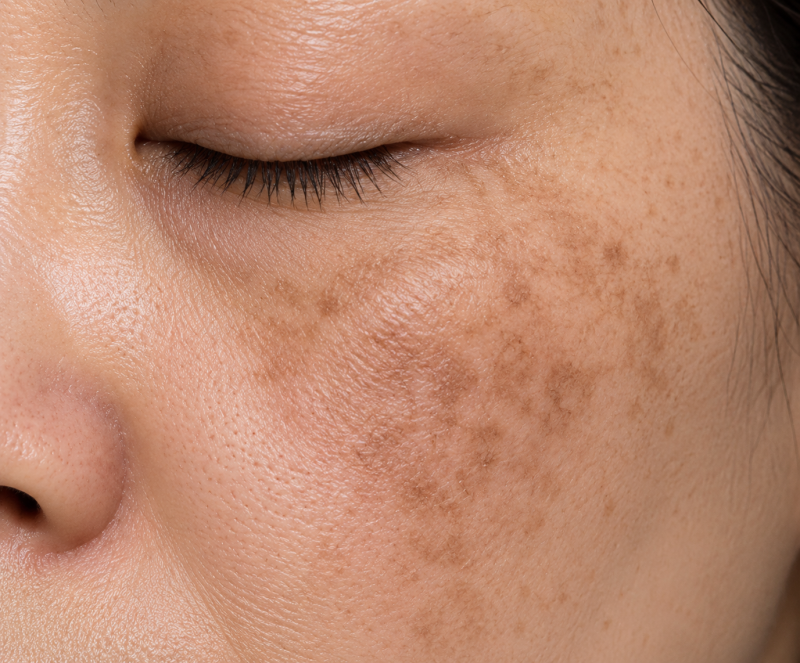
First, melasma is an acquired pigmentary disorder
where brown or grayish-brown patches appear primarily on the face
due to an increase in melanin production.
Rather than appearing as a single, isolated dot,
it typically presents as irregular, diffuse patches
spread over larger areas,
frequently emerging on the cheekbones, forehead, bridge of the nose, and above the upper lip.
A distinctive characteristic is that it rarely appears on just one side;
instead, it usually presents symmetrically in similar locations
on both sides of the face.
Rather than having a single trigger,
melasma is known to develop from a combination
of multiple interrelated factors.
Ultraviolet (UV) radiation and visible light
play significant roles in its onset and aggravation,
while hormonal fluctuations—such as during pregnancy or the use of hormonal medications—
and genetic predispositions are also closely involved.
Therefore,
if you have melasma, consistent daily sun protection
is just as vital as undergoing medical treatments.
• What About Lentigo?
Among the lesions often termed "lentigo,"
the solar lentigo (sun spot) is the most common.
A solar lentigo is a benign pigmented lesion
that frequently appears on skin exposed
to ultraviolet rays over a prolonged period.
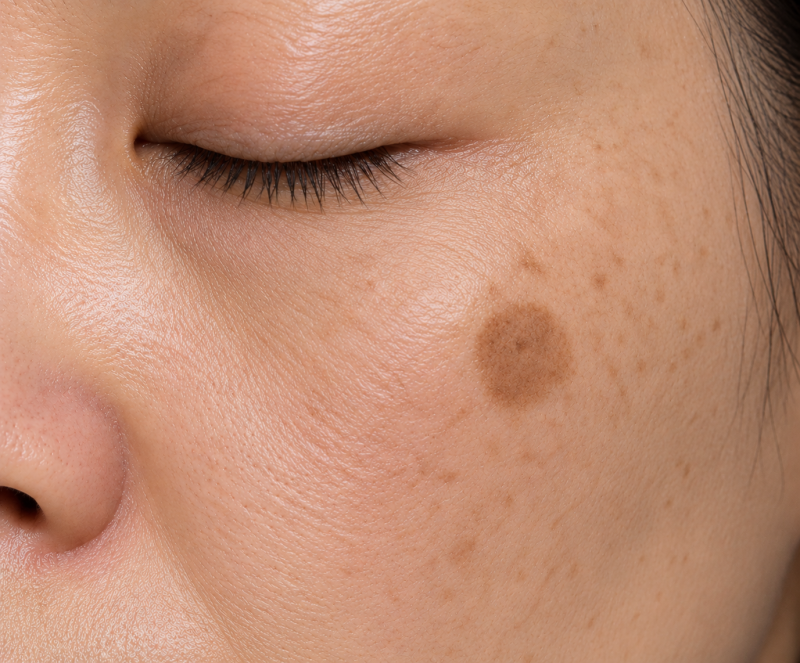
Its shade can range from light yellowish-tan to deep dark brown,
and it can present with round, oval,
or irregularly defined shapes.
Compared to melasma,
it is much more likely to appear as an isolated lesion
with a relatively clear boundary distinguishing it from surrounding skin.
Additionally,
because it is linked to chronic UV radiation exposure,
it commonly appears not only on the face
but also on frequently exposed body areas like the backs of the hands and forearms.
2 Key Factors to Check When Looking at Brown Pigment
So, what should you inspect
when differentiating melasma from solar lentigo?
Before visiting our clinic, instead of merely checking
whether the color is light or dark in the mirror,
it is best to observe the distribution pattern and shape together.
The first factor is how the pigment is distributed.
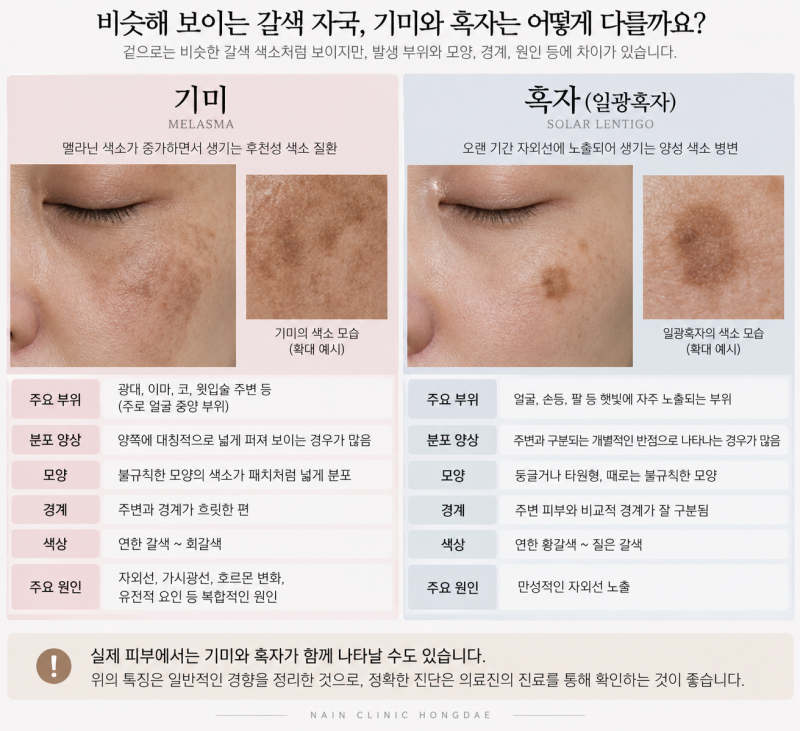
Melasma tends to spread out broadly in irregular patterns rather than appearing as isolated spots. It often presents symmetrically on matching areas on both sides of the face, such as the cheekbones or forehead.
On the other hand, solar lentigines usually present as distinct individual spots clearly separate from adjacent normal skin. However, multiple sun spots can sometimes develop adjacent to each other and merge, which is why distribution alone cannot definitively diagnose melasma versus lentigo.
The second factor is the lesion's shape and borders.
Melasma rarely forms a uniform circular dot;
instead, it often spreads across the skin like patchy clouds.
In contrast, solar lentigines
can be round, oval, or uneven,
yet the boundary between the lesion and normal surrounding skin remains relatively well-defined.
However, caution is warranted here.
You should never assume that "clear borders mean lentigo, blurry borders mean melasma."
Depending on skin depth and individual characteristics,
melasma can also display relatively sharp borders at times.
Therefore, please consider these pointers not as strict self-diagnosis criteria,
but merely as helpful references
when observing your skin concerns.
Can You Distinguish Melasma from Lentigo Just by Looking at Photos?
These days, when searching for dermatologists in Hongdae,
many patients look up sample photos of melasma and lentigo online.
Consequently, during consultations, some patients say,
“My spot looks exactly like the melasma picture I saw online.”
Reference photos are certainly helpful for grasping general characteristics.
However, an in-person medical diagnosis considers far more than immediate color or shape:
we examine when the pigmentation first appeared, how it has evolved,
and the exact pattern of its anatomical distribution.
Crucially, it is very rare for a patient to have only one single type of pigment.
For instance, you might have widespread melasma across your cheekbones
interspersed with individual solar lentigines alongside it.
While everything may look like vague "brown blemishes" in the mirror to you,
a skilled physician must separate each unique lesion during evaluation.
Moreover, if an existing lesion changes in size, shape, or shade,
you should avoid self-diagnosing it as a harmless freckle or sun spot
and get it professionally assessed.
In Pigmentation Treatment: What Matters Before the Device Name
When discussing pigmentation treatments
with patients visiting our clinic in Hongdae,
I am frequently asked:
“Which laser should I get?”
“Which device works best for melasma?”
Because procedural information is so accessible nowadays,
many patients arrive with specific machine names in mind.
However, before choosing any specific laser device,
I strongly believe that identifying the exact type of pigment present in your skin comes first.
We must look beyond superficial color—
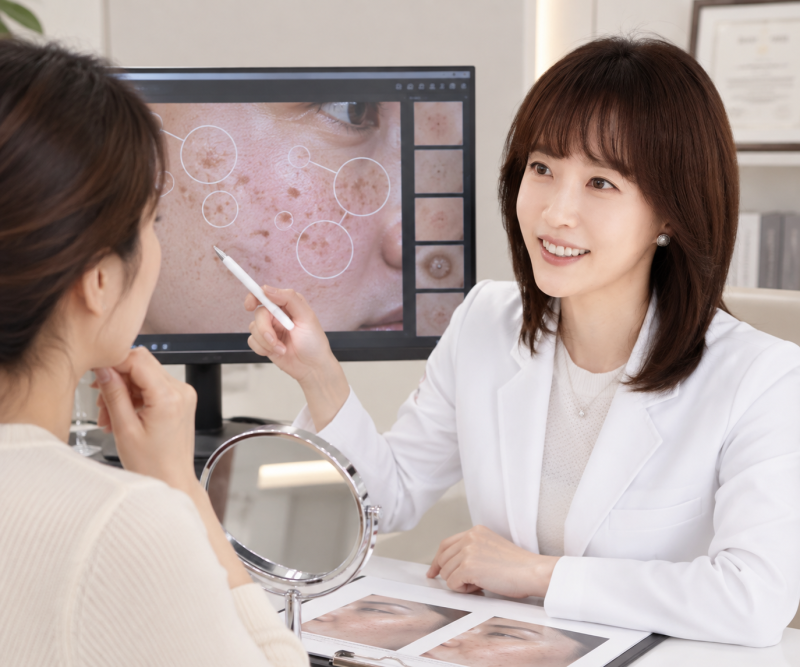
analyzing the lesion's shape, distribution, and overall barrier health,
often utilizing advanced diagnostic imaging like Mark-Vu to evaluate deeper pigment patterns.
Only after this comprehensive assessment can we determine
which pigment to address first and which therapeutic approach to adopt.
Even when lesions share the same medical label,
no two patients share identical skin conditions.
Pigment treatment is not simply about attaching a name to a spot;
it lies in thoroughly evaluating your individual skin condition and designing a tailored roadmap.
I consider that thorough diagnostic process the true cornerstone of successful treatment.

In Conclusion
Although melasma and solar lentigo may look like similar brown spots on the surface,
their diagnostic nuances and treatment directions differ substantially.
If you are exploring pigmentation treatments at a Hongdae dermatology clinic,
instead of asking "Which laser is best?"
I encourage you to first find out: "What kind of pigment is on my skin?"
Carefully examining what needs treatment before tailoring the right modality—
that is where effective pigmentation care begins.
Thank you for taking the time to read this.

“We wish for you to become more beautiful at every single moment.”
Hongdae Dermatology Clinic,
Dr. Go-eun Lee, Nine Clinic Hongdae Branch.

Also,
did you know we have an official YouTube channel?
It is packed with short, informative videos on diverse aesthetic procedures,
so feel free to stop by and check it out! 😊

Goeun Skin by Go-eun Lee Share videos with friends, family, and the world www.youtube.com
#HongdaeDermatology #HongdaeStationDermatology #HongdaeDermatologyRecommendation #HongdaePigmentTreatment #HongdaePigmentLaser #HongdaeMelasma #HongdaeMelasmaTreatment #HongdaeLentigo #Melasma #MelasmaTreatment #MelasmaLaser #Lentigo #AgeSpots #LentigoRemoval #LentigoTreatment #ReepotLaser #MelasmaVsLentigo #DifferentiatingPigmentation #PigmentLaser #FacialPigment #FacialBlemishes #BlemishRemoval #Hyperpigmentation #SkinPigmentation #NineClinicHongdae
Frequently Asked Questions
How can I tell melasma and solar lentigo apart by their outward appearance?
They can be distinguished primarily by their distribution pattern and border definition. Melasma typically appears as wide, irregular, and symmetrical patches across the cheekbones or forehead, whereas solar lentigo presents as discrete individual spots with relatively clear borders separating them from surrounding skin.
Does having clear borders always mean it is a lentigo?
No, you should never make a definitive conclusion based solely on how clear the border seems. While solar lentigines generally have sharper boundaries, certain types or depths of melasma can also present with relatively defined margins. Professional diagnosis by a qualified medical provider is essential rather than self-diagnosis.
Can melasma and lentigo appear on the same face at the same time?
Yes, melasma and lentigines frequently coexist on the same face. For instance, broad melasma patches can spread across the cheek area while distinct sun spots sit within or beside them. Even though they may all appear as similar brown spots on the surface, each requires careful differentiation and targeted treatment.
What should be considered first before receiving pigmentation laser treatment?
Accurately diagnosing the specific type of pigment and evaluating your overall skin condition must come before selecting any specific laser machine. Because melasma and lentigo require different treatment settings and modalities, in-depth evaluation using diagnostic systems like Mark-Vu is essential to design a personalized treatment plan.