2026-09-23
Hongdae Dermatology: Why Ruby Laser (The Ruby Z) is Essential for Nevus of Ota Treatment
Discover why the Ruby Laser (The Ruby Z) is effective for treating deep dermal Nevus of Ota, and why accurate diagnosis and staged treatments matter.
Hello.
I am Dr. Go-eun Lee, Director at Nine Clinic Hongdae.
Some people struggle with persistent bluish or
gray-brown pigmentation around their eyes
or cheekbones for a long time.
It is easy to mistake it for simple blemishes at first,
but it could actually be a Nevus of Ota,
where the pigment is located deep within the skin.
Not all facial pigmentation can be
treated using the same approach.
This is because the appropriate laser and treatment method vary
depending on the type, depth, and the overall condition of the skin.
Today, for those seeking pigmentation treatment
at a Hongdae dermatology clinic,
I will explain the key characteristics of Nevus of Ota
and why the Ruby Laser (The Ruby Z) is widely utilized for its treatment.
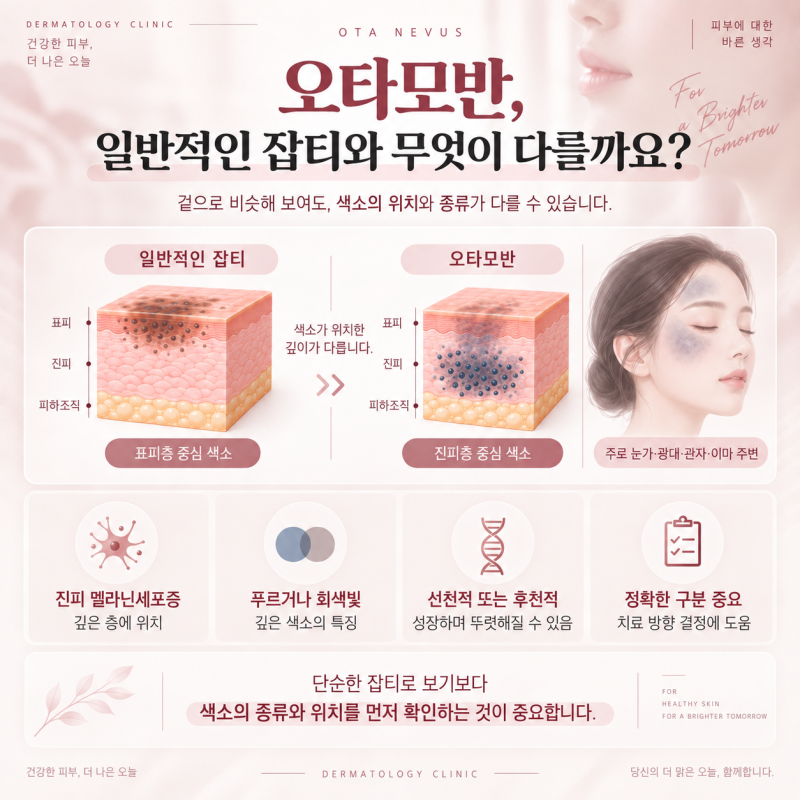
1. Nevus of Ota: How Does It Differ from Common Blemishes?
Nevus of Ota is a form of dermal melanocytosis
that typically appears as blue, gray, or brownish patches
around the eyes, cheekbones, temples, and forehead.
Unlike common epidermal pigmentation,
it is characterized by melanin-producing melanocytes
residing deep within the dermal layer of the skin.
Because the pigment is located deep in the skin,
it often looks not only brown
but blended with bluish or grayish hues on the surface.
While it can be congenital,
it may become more pronounced as one grows,
or it might first be noticed after adolescence.
Therefore, rather than assuming it is a simple blemish
based solely on surface color,
it is crucial to first diagnose the exact type of pigment.
Accurately identifying the pigment's classification and depth
is essential to determine the proper course of treatment.
2. Why the Ruby Laser (The Ruby Z) is Used for Nevus of Ota
Nevus of Ota is a pigmented lesion
where cells containing melanin reside in the dermal layer.
When treating melanin located deep within the skin,
choosing the right wavelength and delivery mode tailored to the pigment's properties
is far more crucial than simply applying aggressive energy.
One of the devices effectively utilized for treating Nevus of Ota
is the Ruby Laser (The Ruby Z).
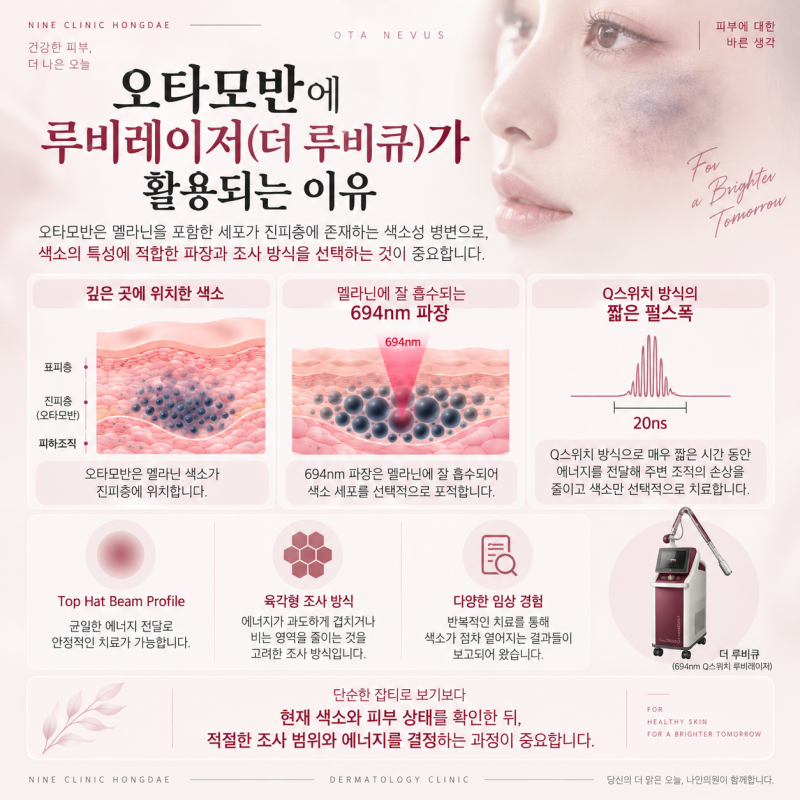
The Ruby Laser utilizes a 694nm wavelength,
which features exceptionally high absorption in melanin.
Operating with a Q-switched mechanism,
it delivers energy over an extremely short duration,
selectively targeting the melanin-containing pigment cells.
The 694nm Q-switched Ruby Laser has long been established
as a gold standard for Nevus of Ota treatment,
and numerous clinical studies have demonstrated significant progressive fading
over repeated treatment sessions.
The Ruby Z from JMEC Japan, used at Nine Clinic Hongdae,
is also a 694nm Q-switched ruby laser.
It is engineered to deliver energy with a short pulse width of 20ns in Q-switched mode,
and it maximizes therapeutic efficacy by combining a Ruby Toning mode.
Furthermore, it utilizes a Top Hat Beam Profile to ensure
relatively uniform energy distribution across the treatment area,
and its hexagonal spot delivery is specifically designed to minimize
excessive beam overlap or skipped gaps during irradiation.
However, even among cases of Nevus of Ota,
the intensity, surface area, depth of the pigment,
and individual skin conditions can vary significantly.
Therefore,
instead of relying solely on the device's specifications,
it is essential to thoroughly evaluate the current pigment and skin condition
before deciding on the appropriate spot size, coverage, and energy levels.
3. Can Nevus of Ota Be Cleared in a Single Laser Session?
During consultations, patients often ask,
“Can it be completely removed if I undergo one strong session?”
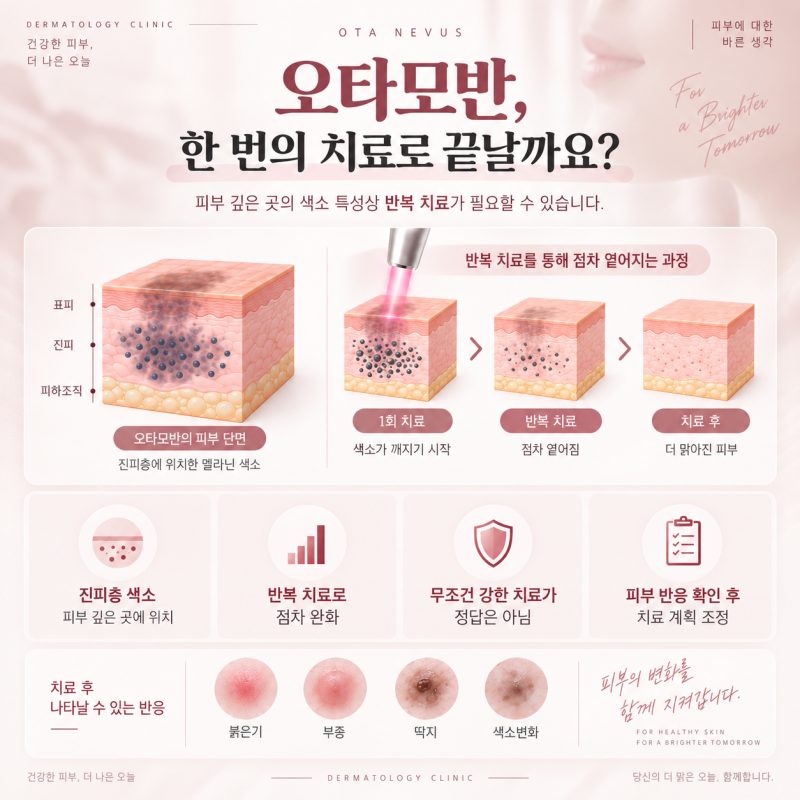
Due to the nature of Nevus of Ota, with melanin distributed deep within the dermis,
it is difficult to evaluate the full outcome based on just a single session.
Various clinical studies using Q-switched ruby lasers
consistently report that the pigment fades gradually
over multiple sessions rather than disappearing all at once.
Attempting to achieve rapid results
by using excessively high energy
is not a recommended approach.
Following treatment,
erythema, swelling, or crusting may appear,
and depending on the individual's skin type, temporary hyperpigmentation
or hypopigmentation could potentially occur.
Therefore, rather than rigidly applying a preset number of sessions,
it is important to observe the skin's biological response and pigment changes
after each session to adapt subsequent treatment intervals and parameters.
4. What to Consider Before Choosing a Device for Pigmentation Treatment
Even though the Ruby Laser (The Ruby Z)
is highly effective for treating Nevus of Ota,
it should not be uniformly applied to all bluish or brownish pigments.
Lesions that appear similar on the surface
can differ substantially in their actual histology and anatomical depth.
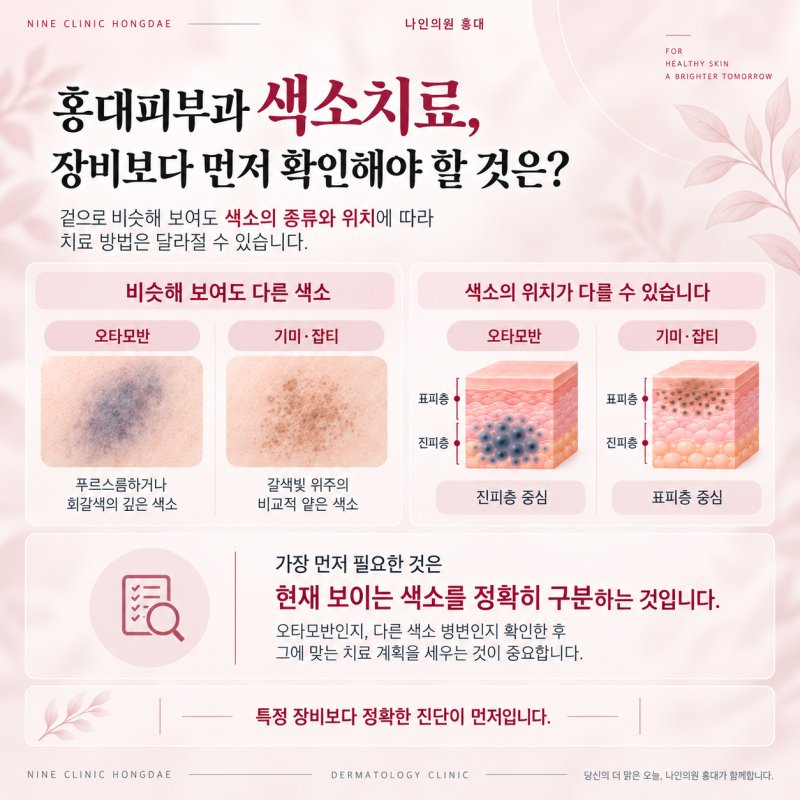
Therefore, the very first step I prioritize in pigment treatment
is accurately diagnosing the exact nature of the visible discoloration.
Once we identify whether it is Nevus of Ota or another pigmented lesion,
we can determine the most suitable laser modality and custom treatment plan.
If you are exploring dermatology clinics in Hongdae because of persistent
bluish or grayish-brown pigment around your eyes, cheeks, or temples,
I recommend getting an accurate assessment of the pigment type and condition first,
rather than focusing only on a specific laser machine.
Accurately understanding pigment characteristics and matching them with the appropriate wavelength and therapeutic technique
is the most vital starting point for successful Nevus of Ota treatment.
Thank you for taking the time to read this😊
We strive to bring out your natural beauty at every moment.
Hongdae Dermatology Clinic,
This was Dr. Go-eun Lee from Nine Clinic Hongdae.

Also,
did you know we have a YouTube channel?
We share concise, practical insights on various aesthetic and dermatological procedures,
so feel free to visit and subscribe 😊

Goeun Skin Go-eun Lee Share videos with friends, family, and the world www.youtube.com
#HongdaeDermatology #HongdaeStationDermatology #HongikUnivDermatology #MapoDermatology #HapjeongDermatology #HongdaePigmentTreatment #HongdaePigmentLaser #HongdaeNevusOfOta #NevusOfOta #NevusOfOtaTreatment #NevusOfOtaLaser #NevusOfOtaClinic #RubyLaser #TheRubyZ #PigmentTreatment #PigmentLaser #SkinPigmentation #Hyperpigmentation #MelasmaTreatment #BlemishRemoval #BlemishLaser #FacialPigmentation #UnderEyePigment #CheekbonePigment #DermatologyLaser #NineClinicHongdae
Frequently Asked Questions
How does Nevus of Ota differ from ordinary blemishes?
The difference lies in the depth of the pigment. While ordinary blemishes are located mostly in the epidermal layer, Nevus of Ota is a dermal melanocytosis with melanocytes situated deep in the dermis. This deeper placement makes it appear bluish or grayish rather than merely brown on the skin's surface.
How does The Ruby Z Ruby Laser work to treat Nevus of Ota?
It utilizes a 694nm wavelength that is highly selective for melanin. By using a Q-switched system to emit high energy in ultra-short pulses, it selectively targets and fragments melanin-containing cells deep in the dermis while minimizing surrounding tissue damage, allowing the pigment to fade gradually.
Can Nevus of Ota be eliminated in a single laser session?
No, it is difficult to eliminate in a single session. Because the pigment is located deep in the dermal layer, multiple treatment sessions spaced apart are necessary to fade the discoloration safely without risking tissue trauma from overly aggressive energy.
What side effects might occur after Ruby Laser treatment?
Temporary redness, swelling, and scabbing may appear after the procedure. Depending on the patient's skin type and energy levels, temporary post-inflammatory hyperpigmentation or hypopigmentation can also occur, which is why energy settings and intervals must be customized by an experienced practitioner.